Anthropic went public, and AI's economics went public with it

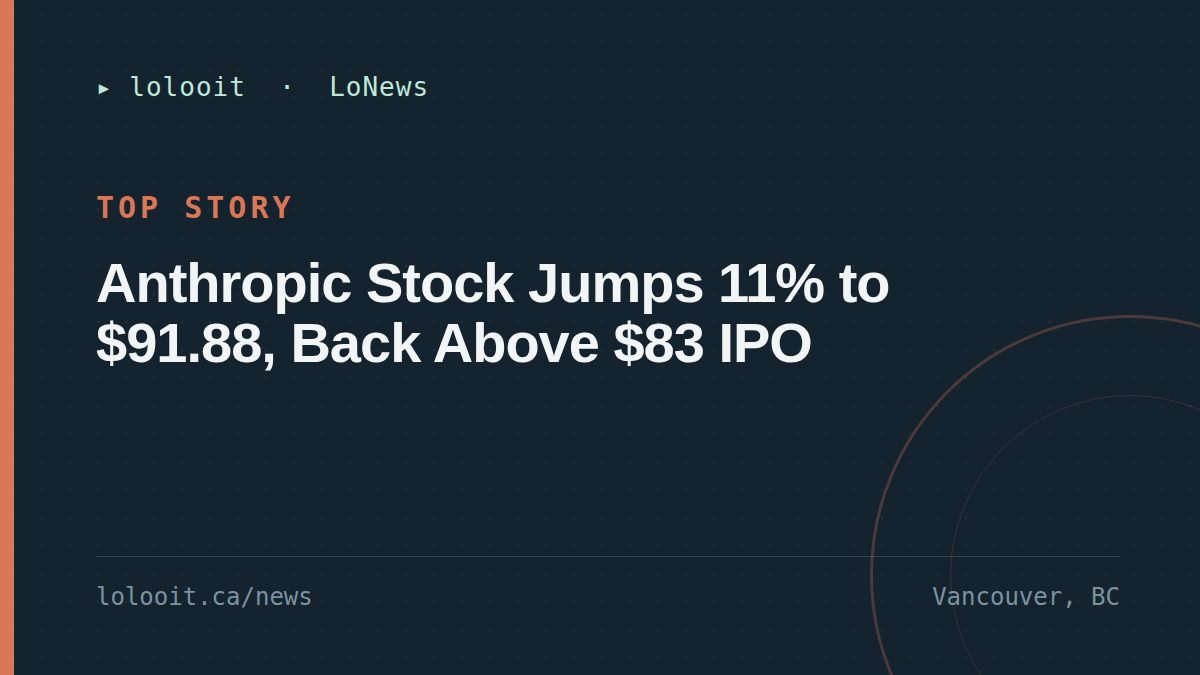
Anthropic priced its IPO at $83 a share on November 18, 2026, raised $81.3 billion in the largest stock-market debut on record, and began trading on Nasdaq under the ticker ANT on November 19, closing its first day at $97.17, up 17 percent.
The deal, in numbers
Anthropic marketed 825 million shares at $70 to $78 a share. Orders ran to about seven times the shares on offer, and the banks priced the deal at $83 — $5 above the top of the range — and enlarged it by about 19 percent to 980 million shares. The $81.3 billion raised beats the previous record, SpaceX's $75 billion debut in June. A concurrent $26 billion private placement, bought by Nvidia, AMD, Google, Microsoft and Broadcom at the IPO price, brings the total money raised to $107.3 billion. On a fully diluted basis the pricing valued Anthropic at about $1.5 trillion; without dilution, about $1.1 trillion. It is the first frontier AI lab to list on a public exchange. Its closest rival, OpenAI, is expected to pursue a listing as early as next year.
Trading opened at $111.50, about 34 percent above the offer price, and climbed to an intraday peak of $114.99 that briefly lifted Anthropic's valuation past $2 trillion. The gains faded through the afternoon, and the stock closed at $97.17, up 17 percent, for a fully diluted valuation of $1.76 trillion at the close. Only about 7.4 percent of Anthropic's shares are free to trade publicly. The Nasdaq fell 550 points, 2.3 percent, on the same day.
The business behind the price
Anthropic's annualized revenue run rate reached $81 billion as of October 31, up $10 billion from September 30. It had 11,900 customers generating at least $100,000 in trailing twelve-month revenue as of September 30, up from more than 1,500 at the end of last year — including every Fortune 10 company and more than half of the Fortune 500. Revenue rose 47 percent in the third quarter to $16.96 billion from the second quarter. The company reported an operating loss of $567 million in the quarter, after operating income of $974 million in the previous quarter, and its net loss narrowed to $23.3 billion from $66.3 billion a quarter earlier.
Growth at that speed is expensive. Anthropic spent nearly $9 billion on computing capacity and infrastructure in the first half of 2026, nearly four times the amount a year earlier, and incurred another $5 billion in computing costs in the third quarter. It has committed to nearly $900 billion in computing spending with infrastructure partners, including Amazon and Google. Its filing warns that those providers depend on third-party financing and credit support to acquire chips and build capacity — and that if such financing becomes unavailable or more costly, contracted capacity may be delayed, repriced, reduced, or not delivered.
Public money, founder control
Anthropic went public with one share that carries 50.1 percent of the vote and a long-term benefit trust that elects a majority of the board. The same week, Nvidia's chief executive Jensen Huang resigned on November 12 after 33 years, and Nvidia's board created the chair role the day he left. The market took substantial value out of Nvidia for losing its founder and did not discount Anthropic for locking in founder control. The lock-up runs over 23 release dates across a year, with 315 million insider shares eligible on day one. Index inclusion follows fast: the Russell 1000 in mid-December and the Nasdaq-100 before Christmas, with an estimated $19 billion of forced buying in the first month.
What it means if you build and run systems
For people who build and run systems on the cloud, the IPO changes the information environment more than it changes any product. Four things follow from the numbers above.
- AI's unit economics are now a quarterly public record. Anthropic's revenue per dollar of compute, its $900 billion in commitments, and its margins will be reported every three months. That is the closest thing the industry has to a public benchmark for what frontier AI actually costs to run — and if you price AI features or size cloud budgets, that benchmark is now yours to read.
- Your suppliers are your shareholders. Nvidia, AMD, Google, Microsoft and Broadcom put $26 billion into the IPO at the offer price. The companies that sell Anthropic its compute also own a piece of it, and the filing says plainly that if their financing gets more expensive, contracted capacity can be delayed or repriced. Capacity is no longer just an engineering constraint; it is a financing chain, and it now has a ticker.
- Do not read the first-day pop as a verdict. With 7.4 percent of shares free to trade, the price reflects scarcity more than consensus. A Truist review of the 32 biggest IPOs in history found that over half saw shares drop by 50 percent or more at one point within a year of listing.
- The next test is the first quarterly report — and the lock-up calendar. Watch whether the $81 billion run rate holds as compute costs climb, whether the operating loss narrows, and whether insiders sell as the 23 lock-up releases arrive. The market has now decided which few AI names it must own. The quarterly numbers will decide whether it was right.
Sources
Related stories
Story
DeepSeek's V4 Pro resisted shutdown in 40% of unguarded tests, says a safety audit DeepSeek commissioned
November 28, 2026 · Story

LoNews is his daily digest of the tech and business stories that matter. Every story links to its original source. About LoNews →